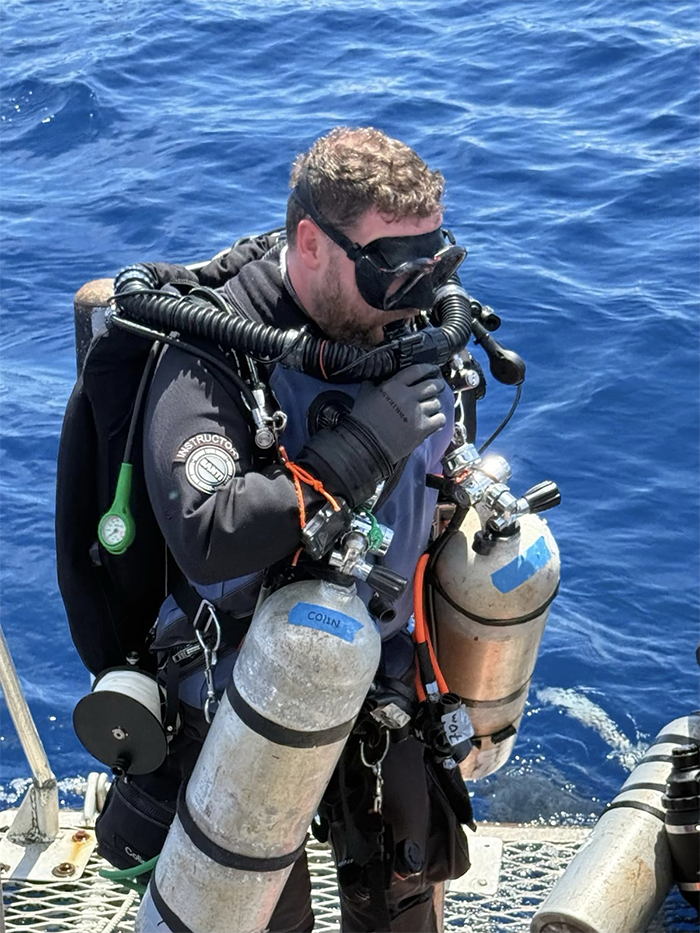
Eric is a seasoned technical diver. Today Eric is planning to do a deep, long dive. He is about to experience the worst dive of his diving career, but not for the reasons you might think.
Eric is 47 years old and has more than 350 logged dives, across different environments and different configurations. He started his technical diving journey two years ago, progressively expanding his skills and knowledge, and recently began training as a cave diver — a journey he knows will require patience and a slow, step-by-step progression toward his goal.
Eric is no daredevil. He is calm, methodical, thorough with his training, and he takes good care of his equipment. Every year, he is declared "Fit to dive." Unfortunately, in technical diving, that's sometimes a misnomer.
What about you? To earn the label "Fit to dive," you filled out the usual medical screening form that's ubiquitous in the diving industry. Maybe you even saw a physician who did a thorough clinical exam of your cardiovascular system and a few other organs you barely knew existed. But is that enough, or does a technical diver need a different standard altogether?
Technical diving asks more of the body than recreational diving ever will. We all know that long decompression, strong currents, and cold water can take a toll on our health and stamina — but that's not the half of it. Technical diving requires a lot more than the ability to frog kick for an hour. Nevertheless, ask most divers what fitness means, and you'll get a surprisingly narrow range of answers, all centered on cardiovascular fitness. Follow that advice and you end up running three times a week for an hour, feeling healthy and miserable in equal measure. If all you do is run, ride a bicycle, or log endless sessions on a rowing machine, you don't become a better technical diver. You become a case study in exercise-induced depression.
Other fitness abilities matter — not only underwater, but importantly, before and after the dive. That's where the real challenge lies: on land, where gravity combined with fatigue and poor mechanics lead to falls, injuries, delayed stress, and perceptual narrowing, all of it detrimental to the many tasks a safe technical dive demands.
LOWER BODY STRENGTH
Ask most cave divers of a certain age in Florida why they chose a sidemount over backmount cylinder configuration. Their answer is not about fitting through smaller restrictions or having a more streamlined profile. Their number one reason is convenience. It takes a lot more strength to walk from the car with a twinset on your back than to carry one cylinder at a time — sometimes with a small cart — and gear up in the water.
Technical diving equipment is heavy: multiple cylinders, rebreathers, DPVs, reels, and more. Every item adds a bit more to the scale and carrying all that gear over uneven terrain to a cave or a boat, or up stairs and ladders, requires leg strength and a spine that can hold up like an exclamation point instead of folding like a question mark.
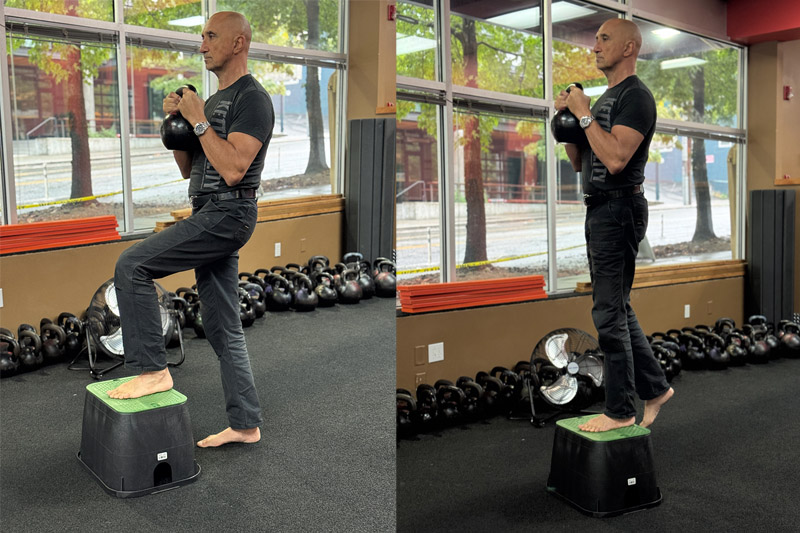
Step-Ups
Slowly step up onto a sturdy platform and back down, leading with one leg at a time. Maintain balance, control, and steady movements throughout the exercise.
Goal: Strengthen your legs and improve stability for climbing boat ladders and stairs.
Platform Height: Keep the step below knee height.
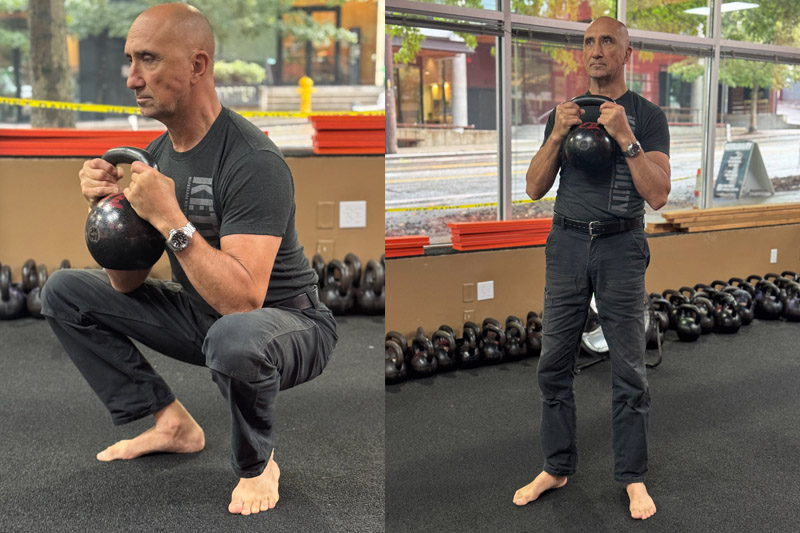
Goblet Squat
Hold a weight close to your chest. Slowly lower into a squat, then return to a standing position. Maintain a neutral spine and neck throughout the movement, keeping your movements slow and controlled.
Goal: Strengthen your legs and core to make standing up from a seated position easier while wearing full scuba diving gear.
UPPER BODY STRENGTH
If you've ever had to pull yourself down or forward along a rope because of a strong current, you know upper body strength plays a critical role in the success of your dive. That can happen in a cave or in the ocean, and a DPV isn't always the solution — they fail, they run out of charge, or they are simply forbidden in some cave systems.
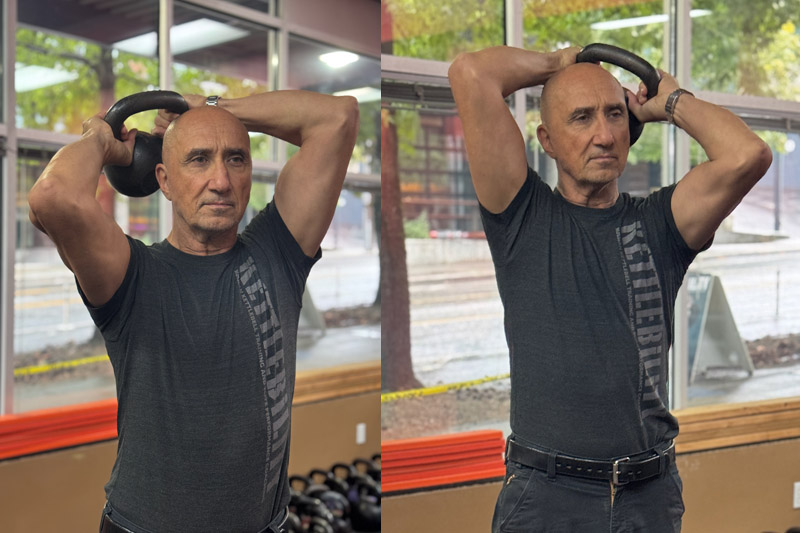
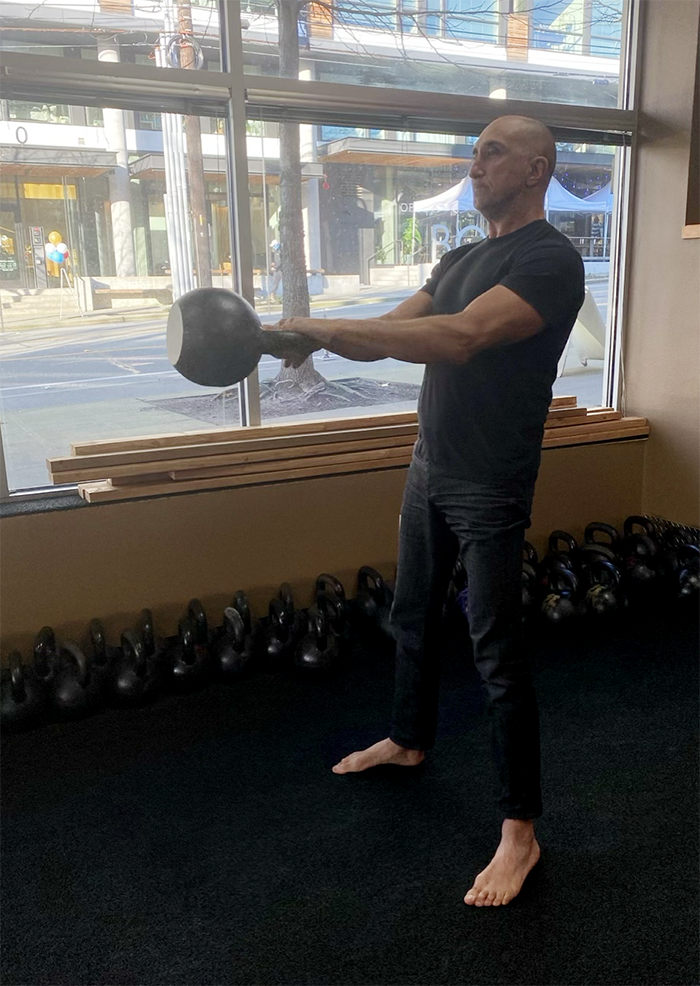
Kettlebell Halo
Hold a lightweight kettlebell upside down and slowly rotate it around your head in a smooth, controlled motion. Keep your core engaged, neck neutral, and shoulders relaxed. Repeat in both directions.
Goal: Improve shoulder mobility, flexibility, and control to make reaching and operating scuba tank valves behind your head easier while wearing full diving gear.
MOBILITY
Mobility and flexibility are not the same thing. You can have extreme flexibility without being able to use it under load or in a fast, complex movement.
You can spot a lack of mobility in divers as they gear up. Dry suits and harnesses are hard to put on. The same goes for putting on or taking off fins, in the water or on land, and for reaching the valves on twinset tanks. All awkward shoulder movements that make divers look like they're wrestling an invisible contortionist.
STABILITY AND BALANCE
Technical divers are top-heavy. All their load sits on the upper body, which doesn't help their balance to begin with. Then put them on a surface that moves, like the deck of a dive boat, say. Add fins to their feet and you get an unstable, hard-to-recover-from, compromised sense of balance. A bit like strapping a fridge to your back, wearing clown shoes, and trying to stay upright on the bed of a moving pickup truck.
WHAT ABOUT ENDURANCE?
Divers with strong aerobic capacity keep their breathing rate and CO2 production lower under load, which reduces the risk of CO2 retention, hypercapnia, and the anxiety that follows — a genuine concern when task-loading is high and deco or bailout gas is limited.
Then there's the emergency scenario nobody plans for, but everyone should prepare for: a long swim against a current, an assisted ascent with an incapacitated buddy, an unplanned surface swim back to the boat. These situations are won or lost on the fitness a diver brought into the water, not the fitness they meant to build someday.
SOME IDEAS ABOUT YOUR TRAINING
Strength doesn't happen overnight. Consistency is the key. There's no need to go to the gym and lift everything and everyone once a year. It's a bit like the old story of Milo, the ancient Greek athlete from Croton who lifted a calf every day until it became a bull — becoming, allegedly, the first athlete to train with progressive overload. Just a bit more weight, volume, or intensity every time you train. Twice a week, in a gym or at home, using implements like barbells, kettlebells, dumbbells, or sandbags. Nothing builds lower body strength like deadlifts, squats, and kettlebell swings. Nothing builds upper body strength like pressing heavy objects overhead or away from the body, in different positions. Add a few pulling movements and some carries, and both your grip and your strength will improve, regardless of your age or your lifting experience.
Core and postural work deserve specific attention, since rebreathers and/or multiple cylinders place unusual loads on the spine and shoulders. Planks and anti-rotation exercises help protect against the strain of asymmetric loading. Learn to do a proper Turkish Get-Up — a skill that demands real trunk stability under load and good postural alignment.
Mobility follows the same rule: consistency is king. You need to improve the mobility of your shoulders and spine, which matters a great deal when you spend so much time underwater in a horizontal position. You'll get far more out of a five-minute mobility routine every day than out of one hard-style yoga class a week. And you won't need to wear bright-colored yoga pants — a big no-no for any respectable technical diver.
Step 2: The necessary adds-on
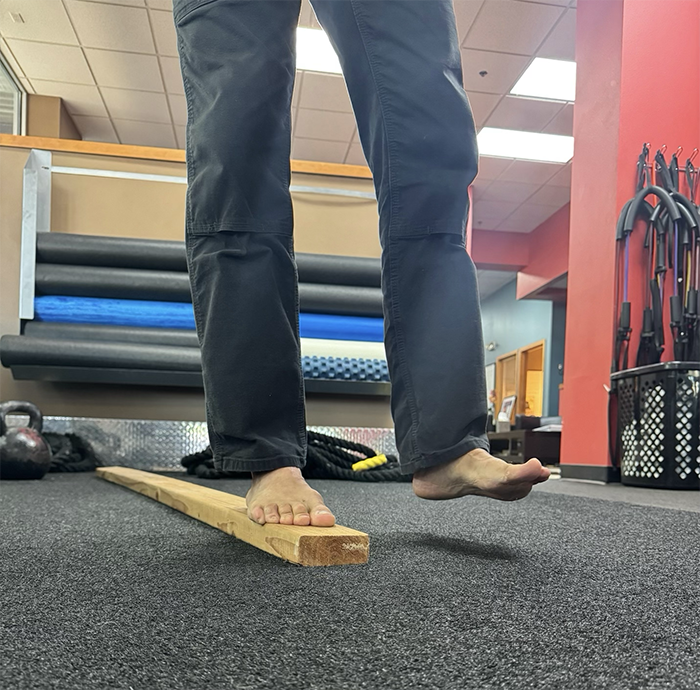
Balance and stability are a whole different animal. It's about training your vestibular system, your nervous system, and your joints to adapt to rapid movement and shifting changes in your center of gravity. There are plenty of tools for that, but the simplest is a small piece of wood, like a 2x4, just wide enough for your foot. Stand on it, on one leg or two, and change the position of your body, progressively faster. Start by standing on two legs while brushing your teeth. Soon enough you'll be able to do the same on one leg with your eyes closed, a feat that will make your friends and relatives question your sanity.
For cardio, some steady-state work twice a week builds the aerobic base that keeps breathing efficient under load. Swimming and fin work are especially valuable, since they train the body in the position and resistance profile it will actually meet in the water. If you don't like swimming — and, strangely enough, a lot of divers don't — just strap on a moderately heavy backpack and walk, preferably up and down hills.
What about nutrition? There's no way around the truth: better body composition helps in any physical activity, technical diving included. It means a lighter bodyweight to move on land, but also less buoyancy (less lead weight) and less drag underwater. That doesn't mean starving yourself or turning every meal into an exercise in calorie tracking, counting almonds like a squirrel with an eating disorder. Just pay attention to the quality of the food you eat. Your body is a temple, not a storage unit — and building strength and muscle will do wonders for your body composition.
Don't forget respiratory training. Through swimming, apnea-style breath work, or simply disciplined breathing drills, you can build the kind of relaxed, efficient breathing pattern that makes you look cool under pressure and keeps gas consumption and CO2 production in check when things get demanding.
For a technical diver, consistency beats intensity. A diver who trains moderately two to three a week, year-round, will be far better prepared than one who trains hard for a month before a big trip to their dream dive. Treat fitness for technical diving the way you treat gas planning and equipment checks: an ongoing discipline, not a one-time task.
Technical diving rewards divers who take their physical preparation seriously, because fitness matters as much as gear, even if it's not as fun to talk about on the Internet.
About the Author
Cedric "Vic" Verdier, has been an Instructor Trainer specialized in rebreather, mixed-gas and cave diving for over 45 years. He is also an NSCA Certified Strength and Conditioning Coach and a StrongFirst Team Leader, working with everyday athletes in his gym, Kettlebility, in Seattle, Washington. His passion for both fitness and diving led him to travel the world extensively and participate in first-time explorations of sub-200m caves and wrecks.






 Eric is 47 years old and has more than 350 logged dives, across different environments and different configurations. He started his technical diving journey two years ago, progressively expanding his skills and knowledge, and recently began training as a cave diver — a journey he knows will require patience and a slow, step-by-step progression toward his goal.